Narrative on the Menstruation Research Conference 2026
This reflection is written by Sabrina Gacad, Founder and Co-Executive Director of Lunas Collective, and Rafaella Potestades, Research Consultant, following their participation in the Menstruation Research Conference 2026 at the Brighton and Sussex Medical School, University of Sussex, where they presented Lunas Collective's ongoing research, Ginhawa at Gaan: Co-Imagining Collective Care and Dignity in the Menstrual Experiences of Filipinos.
The piece recounts their experience at the conference and the conversations, learnings, and connections that continue to shape Lunas Collective's work on menstrual justice, sexual and reproductive health and rights (SRHR), and collective care.

Lunas Collective made a panel presentation of the on-going research “Ginhawa at Gaan: Co-Imagining Collective Care and Dignity in the Menstrual Experiences of Filipinos” during the Menstruation Research Conference 2026 at the Brighton and Sussex Medical School, University of Sussex. Under the theme “Menstrual dignity, inequality and stigma,” we shared insights on the diverse Filipino menstruators’ nuanced understanding of menstrual (in)dignities, a collective vision of menstrual dignity, and our use of a decolonial feminist lens and arts-based and creative data gathering methods. In the same panel, other researchers presented on the following: accessibility and menstrual health and dignity, menstrual practices and religion, creative expression and artistic representations of the ‘weird’ in exploring understandings of the reproductive lifecycle and premature menopause, participatory and community-based efforts to promote menstrual health, and black women’s reproductive health experiences.
In the presentation, we emphasized the value of viewing menstrual health management and menstrual experiences beyond biomedical systems, hygiene discourses, and reproductive centralization. We also reiterated the importance of viewing menstruation as part of the sexual and reproductive health and rights (SRHR) discourse, rather than just advocating and understanding it in isolation. We discussed how an integrated view of menstruation, dignity and SRHR manifests the ways to reach menstrual justice.
During the panel’s question and answer portion, one participant asked for clarity on how to balance the need to connect menstruation with SRHR while not reducing its function to a “reproductive” issue alone. Another participant also asked about the work to challenge dominant and unfair meanings of being a ‘woman’ that are usually associated with menstruation and stigma. In response, the researchers discussed the SRHR framework and how it challenges the “reproductive” function and meanings of femininity and the inequitable burden of care that women are expected to fulfill in society. The discussion also highlighted the effectiveness of arts-based approaches to surface diverse and lived understandings of menstruation and in relation to SRHR (e.g., perceiving a steady cycle as a sign of good health and missing it after menopause, or others wishing to stop their periods to affirm their gender identity). Other speakers shared that it is necessary to normalize what others perceive as “abnormal” and “weird” in the context of menstruation, to ensure inclusion of diverse social identities and to challenge the dominant perception of periods as taboo or shameful.
In the two-day conference, we went to different workshops and learning sessions that are outside of Lunas Collective’s purview. We attended sessions on the intersections of menstruation with sports science, physical movement, reproductive issues such as PMOS (Polyendocrine Metabolic Ovarian Syndrome), menstrual health and technology, and the relationship between mental health and affective sense-making experiences of perimenopausal and menopausal menstruators. In these sessions, Lunas was able to connect with other researchers in the biomedical and health sciences field, and share insights on the social underpinnings of systemic power differences on the everyday life of a menstruator (e.g., in relation to health indicators, lack of access to physical spaces where movement is possible, unpaid care and domestic work and precarious working conditions menstruators face that make it difficult for a ‘work-life balance’). We were able to gather greater insights on the scientific meaning making and understanding of menstrual health and hygiene management, especially in consideration of its impact on menstruators’ mobility and choices when it comes to sports, work, and everyday movement and wellbeing.
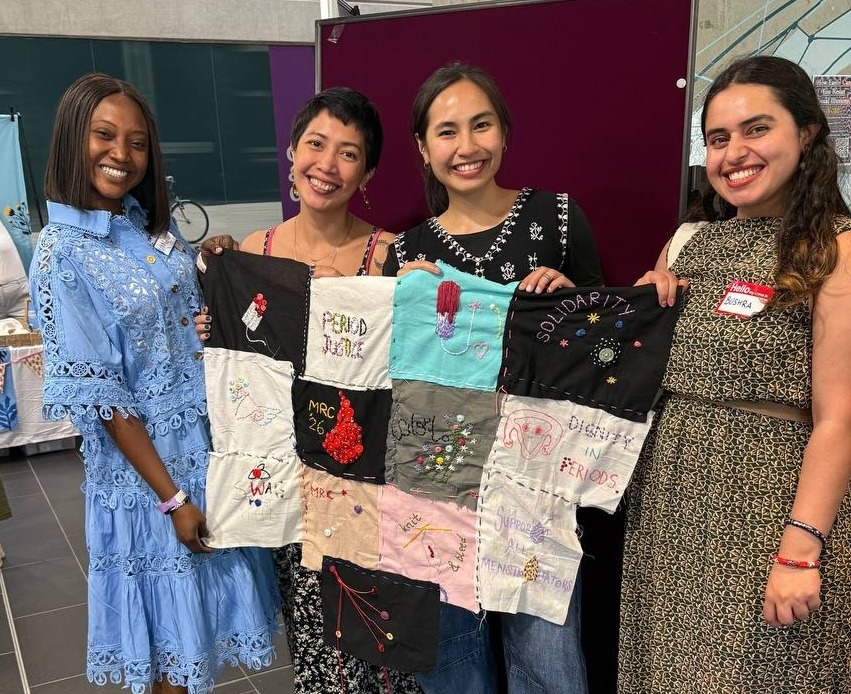
In connecting with the work of advocates and educators, we learned from Margaret Bolaji’s poster about SWAG Initiative’s effort to encourage male allyship in menstruation and dignity and attended a care workshop facilitated by Bushra Mahnoor of Mahwari Justice in Pakistan, where we each crafted messages of menstruation, dignity and justice on patches that joined together to form a tapestry. We also attended a workshop on menstrual education for adolescents in the United Kingdom and Ghana facilitated by Irise.
 Here we found interesting tools to teach students across the ages 9 to 14 about the menstrual cycle, and individual challenges and preferences for particular menstrual products. The tools included a uterus model, sanitary napkins, cups and tampons, and colorful case studies and cut-outs. The interactive methods encouraged adolescents to explore their understandings of menstruation with greater empathy and worked to demystify periods for younger people.
Throughout the conference, Lunas Collective connected with researchers and advocates about the various aspects of our work - education, exploring decolonial feminism in menstruation and the broader SRHR movement, and centering feminist care in community organizing. We noted shared challenges - shrinking windows for funding, enduring stigma against menstruating bodies, and a silo’d view of the various aspects of work on menstruation and health. We also appreciated shared aspirations - expanding the biomedical, the social, and the embodied knowledges of menstruation, health and dignity, promoting education across the lifecycle, creating networks of solidarity and care. The conference has provided us perspective and inspiration, that it is quite powerful to integrate science, technology, art, education, and the multitude of diverse voices and lived experiences in a regional and global effort to promote menstrual dignity and justice.

